Great Seal of the Confederate States of America 22 February 1862 Civil War
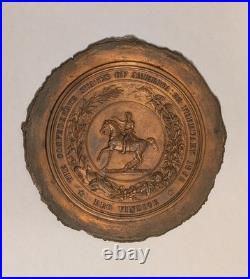
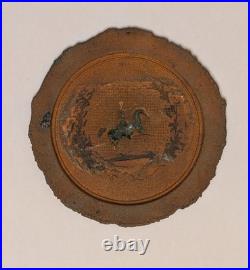

Great Seal of the Confederate States of America 22 February 1862 Deo Vindice, Copper. The medallion itself measures 3.5" diameter, with original bronze molding around the medallion measuring in total 4 1/2". With patina to medallion and verso, some old adhesive remnant to verso. Black, a New York electrotyper.
An electrotype copy of the Great Seal of the Confederacy, produced by Colonel John Pickett in 1872 using the original engraved seal which had been ordered by the Confederate Government. On April 30, 1863, The Confederate Congress agreed by joint resolution to create a seal of the Confederacy which would consist of a device representing an equestrian portrait of Washington (after the statue which surmounts his monument in the Capitol Square at Richmond) surrounded with a wreath of the principal agricultural products of the Confederacy. " The seal, it was determined, would also incorporate the Latin phrase "Deo Vindice" or "God Will Vindicate. Secretary of State Judah P.
Benjamin asked the Confederate commissioner in England, James Mason, to find a suitable engraver to design the seal. Wyon of London was chosen for the job, which he completed in 1864. The seal finally arrived at Richmond in August, 1864. When the city fell to Union forces in April, 1865, the seal was smuggled out by the wife of William J.
Bromwell, a clerk in the State Department. In 1872, Bromwell's attorney, John T. Pickett, had electrotype copies of the unique original seal made in copper or with silver or gold plating. Before giving the original seal as a gift to Thomas Selfridge, USN.
Today, the original electrotype impressions of the Great Seal of the Confederacy are rare.