Civil War Confederate Lieutenant General Stephen D. Lee Signed Cut PSA
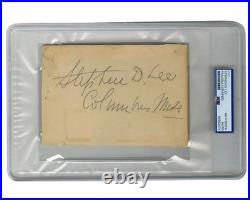


Title: Confederate Lieutenant General Stephen D. Lee Large Autograph Cut - Fort Sumter, Vicksburg, Atlanta and Army of Tennessee Commander - PSA/DNA Certified Authentic, Certification No. Description: A substantial autograph cut boldly signed Stephen D. Beneath his signature, Lee adds Columbus Miss.
, identifying Columbus, Mississippi, where he lived after the war and became an important figure in education and Confederate veterans organizations. The autograph is executed in pencil or graphite on a large, rectangular sheet that has naturally toned with age. Lee's signature is unusually expansive, extending prominently across the upper portion, while the location inscription occupies much of the area immediately below. The piece displays age-related toning, scattered discoloration, and traces consistent with former mounting or album placement. The reverse is blank and also exhibits uniform age toning.
The inscription reads in full. Historical Context: Stephen Dill Lee was born in Charleston, South Carolina, on September 22, 1833, and graduated from the United States Military Academy at West Point in 1854, ranking seventeenth in a class of forty-six. After serving approximately seven years in the United States Army, he resigned his commission in February 1861 and entered Confederate service. Lee was present at one of the defining opening episodes of the Civil War.
Serving as an aide to Confederate General P. Beauregard at Charleston, he was among the officers who delivered the demand for the evacuation of Fort Sumter to Major Robert Anderson before Confederate batteries opened fire on April 12, 1861. He also participated in the negotiations for the fort's evacuation the following day. Lee subsequently developed a reputation as an artillery commander. During 1862 he participated in the Peninsula and Seven Days campaigns, Second Manassas, and Antietam.At Antietam, his artillery was engaged in the intense fighting around the Dunker Church sector. In November 1862 he was promoted to brigadier general and sent west, where his career became closely connected with the defense of Mississippi and the Mississippi River. At Chickasaw Bayou in December 1862, Lee exercised tactical command of Confederate forces that successfully resisted Major General William T. Sherman's attack north of Vicksburg. He subsequently commanded a brigade during the Vicksburg Campaign, fought at Champion Hill, and participated in the defense of Vicksburg itself.
The National Park Service order of battle records Lee's brigade as including the 20th, 23rd, 30th, 31st, and 46th Alabama Infantry regiments, together with Waddell's Alabama Battery. When Vicksburg surrendered on July 4, 1863, Lee was among the Confederate defenders captured. His rise continued in 1864. Promoted to lieutenant general, Lee commanded a corps of the Army of Tennessee during the Atlanta Campaign.
His troops fought at Ezra Church and Jonesboro and later participated in the Tennessee Campaign, including the battles of Franklin and Nashville. Lee was wounded during the retreat from Nashville but recovered sufficiently to return for the closing operations of the war in North Carolina. Lee's postwar career gives the Columbus Miss. After the conflict, he settled in Mississippi and entered public and educational life. In 1878 he was elected to the Mississippi Senate, and in 1880 he became the first president of the Agricultural and Mechanical College of the State of Mississippi, the institution now known as Mississippi State University.The university confirms that its first students arrived in 1880 during Lee's presidency. Lee also became deeply involved in preserving and shaping public memory of the Civil War. He served as president of the Mississippi Historical Society, helped organize the United Confederate Veterans, and assisted in organizing the Vicksburg National Military Park Association. The National Park Service notes that his postwar historical activities also contributed to the development and promotion of the Lost Cause interpretation of the Confederacy. He died in Vicksburg in 1908 and was buried in Friendship Cemetery in Columbus, Mississippi.
Authentication & Encapsulation: The autograph has been professionally authenticated and encapsulated by PSA/DNA. The PSA label identifies the artifact as "CUT / STEPHEN D LEE / PSA/DNA CERTIFIED" and designates the signature AUTHENTIC AUTO. The certification number displayed on the holder is 85952474.The oversized transparent holder permits examination of both the signed face and blank reverse while protecting the original paper. The large format is particularly effective for displaying Lee's expansive signature and the accompanying Columbus Miss. Closing Appeal: An impressive autograph of a major Confederate commander whose Civil War career stretched from Fort Sumter through Vicksburg, the Atlanta Campaign, Nashville, and the final operations in North Carolina. Lee's progression from artillery officer to lieutenant general, combined with his important postwar role as the first president of what became Mississippi State University, gives this piece significance extending beyond the battlefield.
The unusually large signature, handwritten Columbus Miss. Location, substantial period paper, and PSA/DNA authentication make this a distinctive display piece for a collection centered on Civil War generals, Vicksburg, the Army of Tennessee, Confederate history, or nineteenth-century American military autographs.